Hard Water Signs: What That Crust, Spot or Smell Means
Few people search for a softener first; they search for the white crust on a faucet or the film on a glass. Find what you are seeing below. Each answer comes first, then the page that covers the fix.
Most hard water signs in Omaha trace to calcium and magnesium, which the utility reported at an average of 9 grains per gallon in 2025. Crust, spotting, stiff laundry and water heater scale are hardness. A pool smell or a rotten-egg odor is not, and a softener will not fix either one.
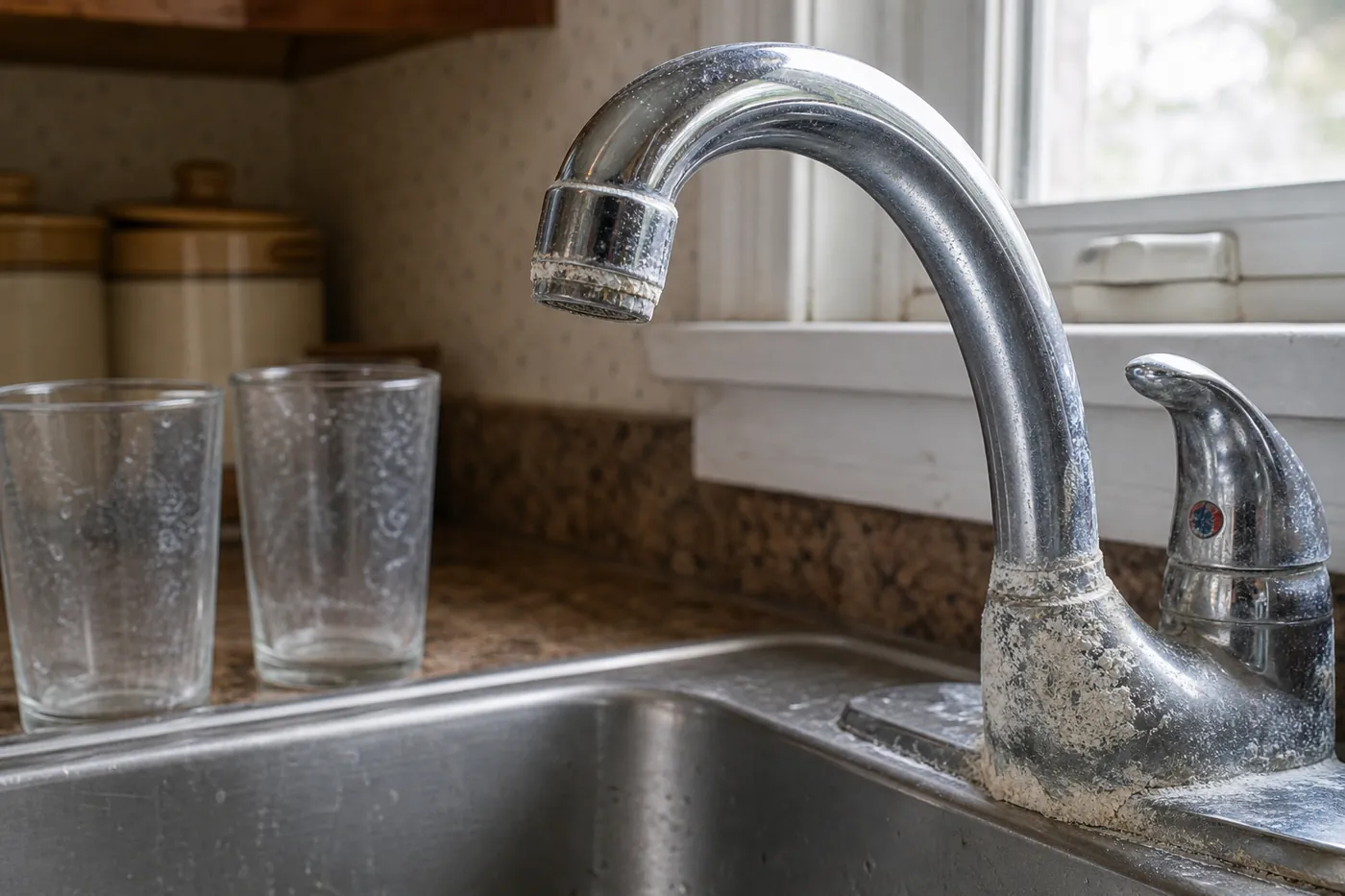
What is the white crust on my faucets and showerhead?
Usually calcium carbonate, the main mineral in hard water, left behind as droplets dry. Vinegar dissolves it, but on 9-grain water it comes back within weeks. If it builds on every fixture in the house, the lasting fix is removing the hardness itself; see softener vs filter vs conditioner.
Why are my glasses and dishes spotty?
Spots and cloudy film are minerals drying on the surface, and a dishwasher heats the water, which helps scale form. Rinse aids help a little. Softened water stops most of it; if spots persist after a softener goes in, check the hardness setting on the salt and maintenance page.
Why does soap barely lather?
Hardness minerals react with soap, so it takes more soap or detergent to get things clean (U.S. Geological Survey). The leftover is the gray ring in a tub and the film on skin and hair. A softener removes the minerals behind it; the sizing page shows how big a unit your household needs.
Why is my water heater rumbling or popping?
Often scale. Heating hard water drops calcium carbonate out as a solid, and it settles at the bottom of a tank heater, where water trapped beneath it boils and pops. Flushing the tank helps for a while. Softening the water before it reaches the heater stops new buildup, which is why softeners go ahead of it; see softener installation.
Why is my laundry stiff or dingy?
Detergent loses strength in hard water, so minerals and soap residue stay in the fabric, and more detergent is the usual workaround. Softened water lets a smaller dose clean as well. If laundry stays stiff after a softener goes in, check that the unit has salt and is actually regenerating.
Water pressure dropped after the softener went in. Why?
M.U.D. notes that softeners can cause a sudden change or drop in pressure, and its first test is simple: switch the softener to bypass and see whether pressure improves. If it does, the problem is inside the unit, such as a clogged resin bed or a valve too small for the house. See maintenance and repair.
My water smells like a swimming pool. Is that hardness?
No, that is the disinfectant. M.U.D. uses chloramine, which does not boil off or fade in open containers as quickly as chlorine (2025 Water Quality Report). A softener will not change it. A filter rated for chloramine, at the kitchen tap or for the whole house, addresses the taste; compare options on the softener, filter or conditioner page.
What about a rotten-egg smell or orange stains from a well?
Those point to hydrogen sulfide and iron, which are well-water problems more than city ones; M.U.D. reported only 0.06 ppm of iron in 2025. Nebraska Extension says hydrogen sulfide, or iron above 5 ppm, reduces how well a softener works and calls for treatment ahead of it. Test the well first, then size the softener from the results.
Tell us about your water
A line is enough: crusty faucets, an old softener that quit, a house with no softener yet. One independent water treatment specialist who works in Omaha will get in touch to talk it through.