Softener vs Filter vs Conditioner for Omaha Tap Water
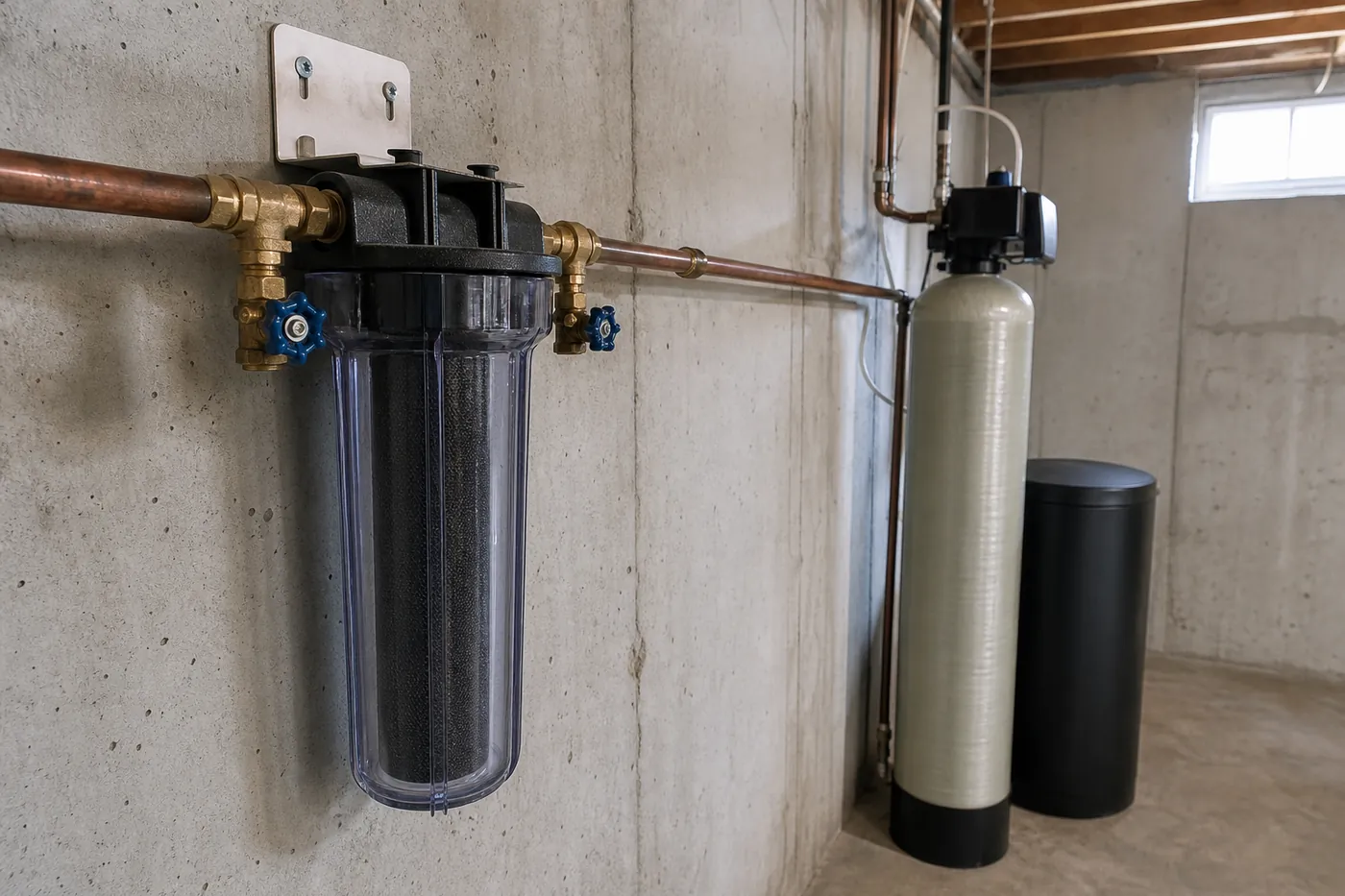
A softener, a filter and a conditioner are often sold as if they were the same thing. On Omaha water they solve three different problems, and buying the wrong one leaves the problem you actually have.
A salt-based softener is the only one of the three that removes calcium and magnesium, the source of Omaha's 9-grain hardness. A carbon filter treats taste and odor such as chloramine. A salt-free conditioner changes how minerals behave without removing them. This Old House lists salt-free systems at $800–$4,000.
Which problem do you have?
- White crust, spots, scale in the water heater: hardness. A softener removes it.
- A pool-like taste or smell: disinfectant. M.U.D. uses chloramine, a mix of chlorine and ammonia that does not boil off or fade in an open pitcher as fast as chlorine (2025 Water Quality Report). A filter rated for chloramine handles that; a softener does not.
- An aquarium or a pond: chloramine again. M.U.D. says fish owners need equipment or products that neutralize it.
- A specific contaminant: read the utility's report first, then pick a filter certified for what you want removed.
How does a salt-free conditioner differ from a softener?
Template-assisted crystallization units, the common salt-free type, convert dissolved hardness into tiny crystals that are less likely to stick as scale. They do not take the calcium and magnesium out, so the water still tests hard. Nebraska Extension notes that standardized testing for these devices has not been developed and that results vary from home to home, and it finds no scientific consensus that magnetic units work at all. A conditioner can make sense where a drain line or salt is a problem; ion exchange is the method that actually removes hardness.
Do Omaha homes need a filter for PFAS?
M.U.D. tested for 29 PFAS compounds under EPA's fifth Unregulated Contaminant Monitoring Rule, and its 2025 report lists every result below the practical quantitation limit, the lowest level the lab can reliably measure. A softener does nothing for PFAS in any case. If you still want a drinking water filter, an under-sink reverse osmosis unit runs $150–$1,300 in This Old House's 2026 guide; choose one certified for the contaminants you care about.
Can one setup do both?
Yes. A whole-house carbon filter ahead of the softener treats taste at every tap, then the softener removes hardness. Bob Vila, citing Angi data in 2022, put whole-house filtration at $1,000–$4,000. Filters are rated separately for chloramine, so ask what media a quote includes and how often it needs changing. Prices for each piece are in the water softener installation cost guide for Omaha.
Questions homeowners ask
Do I need a whole-house filter on Omaha city water?
Not to meet drinking water standards: M.U.D. reports that its water meets all state and federal standards, and its 2025 PFAS results were all below the lowest level the lab can reliably measure. A whole-house filter is a comfort choice for chloramine taste or smell. Bob Vila, citing Angi data in 2022, put whole-house systems at $1,000–$4,000.
Tell us about your water
A line is enough: crusty faucets, an old softener that quit, a house with no softener yet. One independent water treatment specialist who works in Omaha will get in touch to talk it through.