Omaha Water Hardness, Read From the Utility's 2025 Report
Omaha water hardness is set twice: once by the rivers, then again by the treatment plants. The numbers in the utility's annual report show how much is left by the time water reaches a faucet.
M.U.D.'s 2025 Water Quality Report lists average total hardness of 9 grains per gallon, or about 154 mg/L, with results from 8 to 13 grains. Calcium averaged 45 ppm and magnesium 11 ppm. The utility lime-softens to about 170 mg/L and removes roughly 35% of raw Missouri River hardness at Florence.
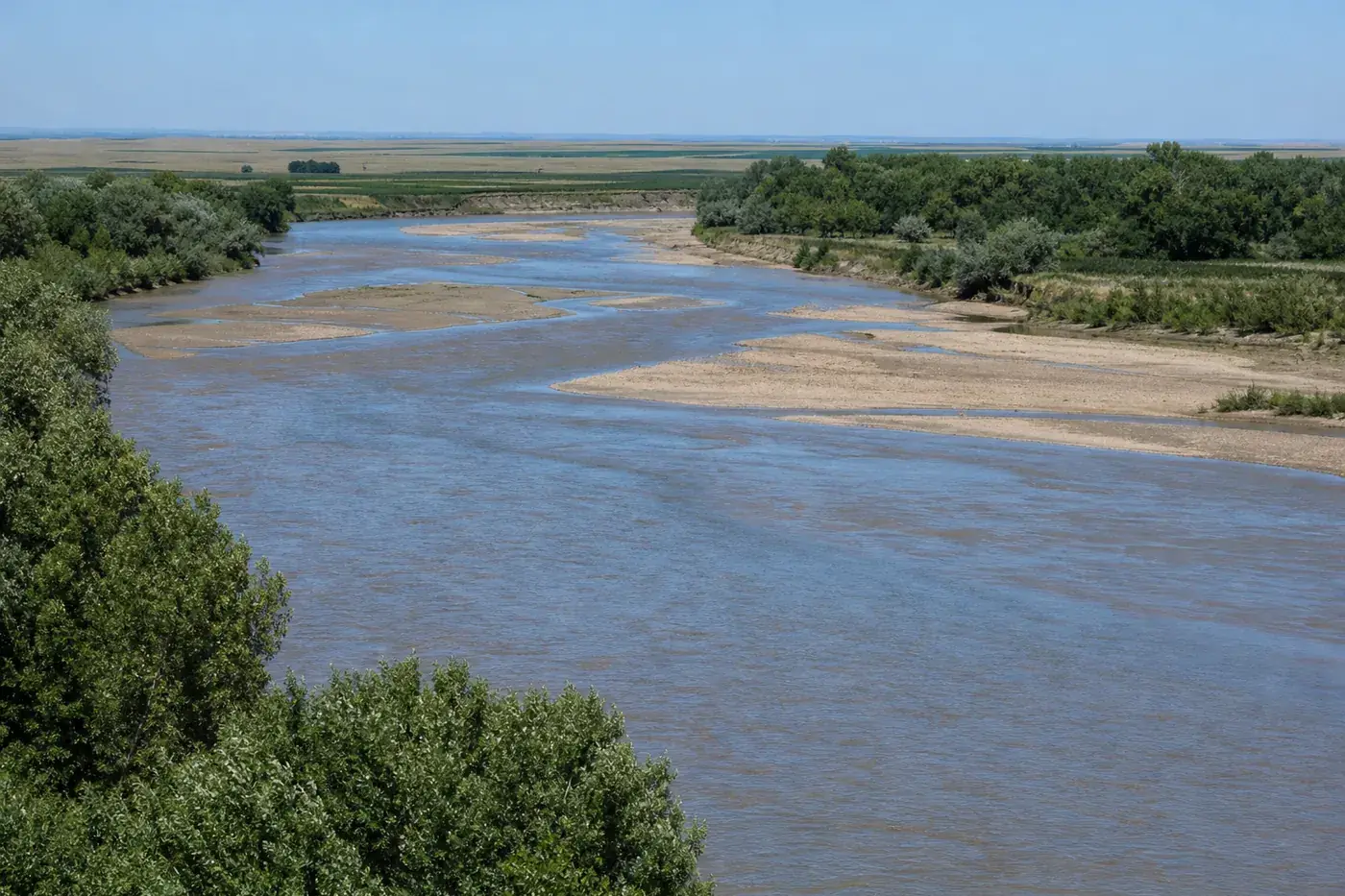
Where does Omaha's water come from?
The Metropolitan Utilities District draws from two rivers. The Missouri River, classed as surface water, supplies the Florence plant. The Platte River supply, which the utility classes as groundwater under the direct influence of surface water, comes from its Platte South and Platte West wellfields. Together the three plants serve more than 231,000 homes and businesses and nearly 600,000 people, delivering an average of 90 million gallons a day (2025 Water Quality Report).
What does lime softening at the plant do?
Each plant runs a clarification and softening step that removes silt and part of the hardness before filtering and disinfection (2025 Water Quality Report). The lime added drops out along with calcium and magnesium. M.U.D. says it softens to about 170 mg/L, the same as 10 grains per gallon, and that Florence removes about 35% of the hardness in raw Missouri River water. A home softener works differently: it trades the remaining hardness for sodium or potassium, and the water softener installation cost guide shows what that costs.
Reading the mineral table
- Total hardness: average 9 grains per gallon, range 8 to 13. Multiply by 17.1 for mg/L: about 154 on average and about 222 at the top.
- Calcium and magnesium: 45 ppm and 11 ppm on average, the two minerals that form scale.
- pH: 8.98 on average, on the alkaline side.
- Dissolved solids: 396 ppm on average. Softening swaps minerals rather than removing them, so this number barely moves.
- Sodium: 29 to 75 ppm before any home softener adds more.
- Iron: 0.06 ppm on average, a low level.
On Nebraska Extension's scale, 7 to 10.5 grains is hard and anything above 10.5 is very hard, so most results sit in the hard band and the highest cross into very hard.
Not on M.U.D. water?
If your water bill comes from another utility, read that system's own report; the Safe Drinking Water Act requires public water systems to publish one every year. If you are on a private well, test it. Nebraska's Department of Water, Energy and Environment recommends coliform and nitrate tests, and hardness and iron results tell an installer what a softener has to handle. Then work out capacity on the sizing page.
Sources
- U.S. Geological Survey Water Science School: Hardness of Water
- Nebraska Extension NebGuide G1274: Drinking Water, Hard Water (Calcium and Magnesium)
- U.S. EPA: Consumer Confidence Reports (annual water quality reports)
- Nebraska Department of Water, Energy and Environment: Private Well Testing
- Nebraska DHHS Public Health Environmental Laboratory
Tell us about your water
A line is enough: crusty faucets, an old softener that quit, a house with no softener yet. One independent water treatment specialist who works in Omaha will get in touch to talk it through.