Water Softener Sizing for Omaha Households
Water softener sizing in Omaha is arithmetic, not guesswork. You need two numbers, the hardness of your water and how much of it the household uses, and the rest follows.
Multiply people by daily water use by hardness. With the U.S. Geological Survey's 80 to 100 gallons per person and M.U.D.'s 9-grain average, a family of four removes about 2,900 to 3,600 grains a day. A unit that regenerates about once a week needs roughly 20,000 to 25,000 grains of usable capacity.
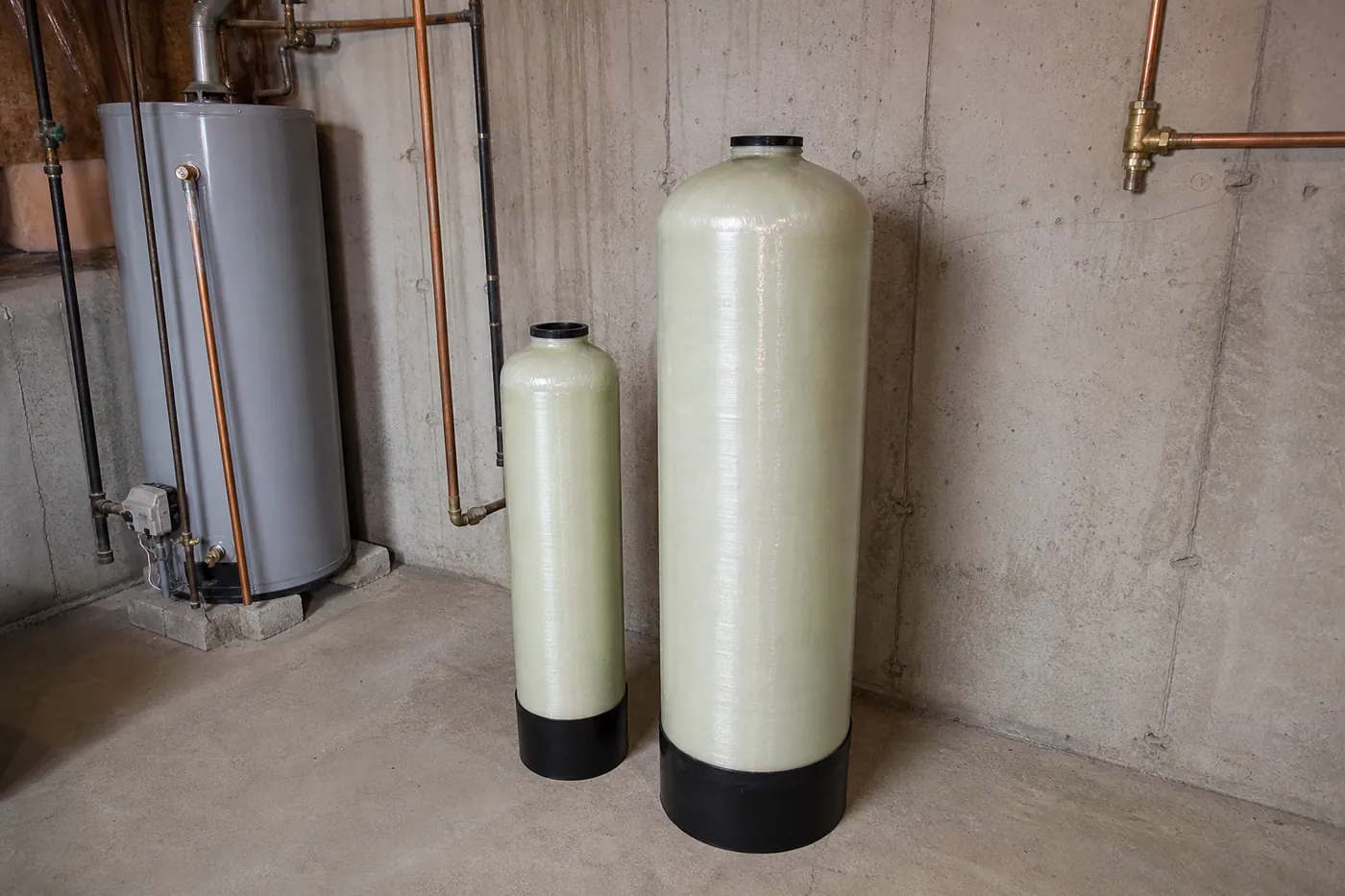
How many grains does your household use?
Use 9 grains for an average M.U.D. reading or 13 to cover the top of the 2025 range, and 80 to 100 gallons per person per day (U.S. Geological Survey):
- Two people: 1,440–1,800 grains a day at 9 grains per gallon; 2,080–2,600 at 13.
- Four people: 2,880–3,600 at 9; 4,160–5,200 at 13.
- Six people: 4,320–5,400 at 9; 6,240–7,800 at 13.
Toilets are the largest indoor use, per the USGS, and a whole-house softener treats them along with everything else. Hose bibs left on hard water stay out of the count.
Why is rated capacity not usable capacity?
A unit labeled 32,000 grains reaches that figure only at its heaviest salt dose. Set for salt efficiency, the same resin delivers noticeably less, and the valve holds back a reserve so the water does not turn hard before the next regeneration. Ask the installer what usable capacity the unit gives at the salt setting they plan, then divide by your daily grains to see how often it will regenerate. Regenerating too often wastes salt and water, at about 50 gallons a cycle (Nebraska Extension).
When does a twin-tank unit make sense?
A single tank goes offline while it regenerates, which is why most are set to recharge in the small hours; Nebraska Extension gives midnight to 4 a.m. as the usual window. A twin-tank unit keeps one tank in service while the other recharges, so soft water never stops. It suits large households, homes with showers running at odd hours, or water near the 13-grain end of M.U.D.'s range. Fixr puts twin-tank installs at $1,500–$3,000, against $650–$1,500 for a single tank.
Does flow rate matter in a bigger house?
Yes. Capacity is how much hardness the unit holds; flow rate is how much water it can pass at once before pressure sags. A house with three bathrooms running at the same time needs a valve and pipe size that keep up. Fixr's equipment prices by capacity run from $400–$1,000 for a 32,000-grain unit to $1,700–$2,500 for 96,000 grains. Compare full installed prices in the Omaha water softener installation cost guide.
Questions homeowners ask
What size water softener does a family of four need in Omaha?
On M.U.D. water at the 9-grain average, a family of four uses about 2,900 to 3,600 grains a day, so a unit with 20,000 to 25,000 grains of usable capacity regenerates about weekly. A model rated around 32,000 to 40,000 grains often gets there at an efficient salt setting; ask the installer to confirm the usable figure.
Tell us about your water
A line is enough: crusty faucets, an old softener that quit, a house with no softener yet. One independent water treatment specialist who works in Omaha will get in touch to talk it through.